
Posted on January 12, 2023
Thinking About Resolutions
By Justin Watson
What would you do and who would you become if you knew you couldn’t fail?
Start a business? Run a marathon? Ask out that guy? Lose 25 pounds? Take a vacation?
Recently, many of us wrestled with some version of this question. We looked at our dreams, our hopes, and even our shortcomings and tried to determine if we have what it takes to make them happen in 2023.
The intent? To hopefully take steps toward living a better life. Whatever that means.
“Whatever” is usually inspired by a circumstance.
- You were recently laid off, so it’s finally time to start the business.
- There’s some tension in your marriage, and you believe a vacation together will help you reconnect.
- The button on your shirt popped off at Christmas dinner and flew into Aunt Sally’s mouth causing her to choke. Definitely time to lose some weight.
Whatever the circumstance, 37% of us will come up with an answer for the question of what we want to accomplish and who we want to become this year.
One-third of these resolution-setters will give up within the first 30 days.
Most people determine that it’s just not worth it. Likely because, at one point, they failed to keep their resolution which became proof that certain change or growth might be impossible. It is what it is.
What if the problem isn’t the resolution itself?
What if the problem is actually how you’re thinking about the circumstance that is highlighting that a change might be necessary?
Recently, I was listening to a podcast and Dr. Katrina Ubell taught through what she called the Thought Model. I have to admit, it’s not a new concept if you’ve been around Pure Desire for any length of time. It’s really similar to what we refer to as the Iceberg Illustration.
But listening to Dr. Ubell’s explanation of the model brought this concept to life for me in a new way.
Here’s how the Thought Model works:
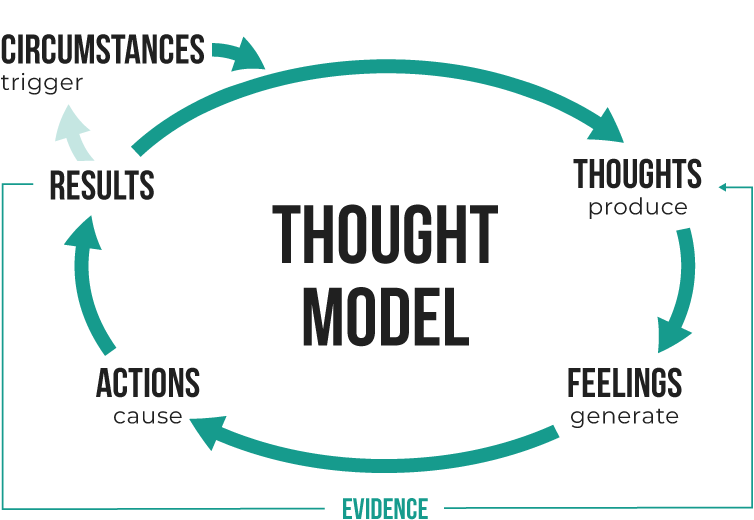
Circumstances
Circumstances are verifiable facts. They’re not based on opinion or up for debate. Everyone, everywhere would agree. When I step on the scale and see the number, it’s not up for debate. The number is a verifiable fact. This number isn’t communicating anything to me beyond the “gravitational pull of the earth” on my body in that specific moment.
Circumstances themselves are not good, bad, right, or wrong. They just are.
Thoughts
How we think about our circumstances is what gives it meaning. When I see the number on the scale, I usually think something along the lines of, “I’m fat” or “How did I gain this much weight again?” My wife says I’m not fat. She’s not wrong.
But these are my thoughts about the number on the scale. The scale doesn’t start yelling obscenities at me. My brain does. Why? Because at one point I worked really hard and lost 80 pounds. Three years and our first child later, I haven’t quite cracked the code to managing this lower weight. And my brain doesn’t let me forget it.
You know what my brain does conveniently let me forget? I’m still down roughly 35 pounds from my highest ever weight. The truth is that, even if my brain forgets, I might not be where I want to be—there’s definitely room for improvement—but I’m not where I once was.
The number itself is not the issue. How I think about the number causes me to feel a certain way about my circumstance.
Feelings
What’s the difference between a thought and a feeling? While a feeling is usually one word, a thought is a sentence. Our thoughts produce feelings.
“I’m fat” is a thought that produces feelings of disgust, shame, and embarrassment. Especially when I compound “I’m fat” with the thought “I used to weigh so much less.” Now, I feel like a failure.
In Pure Desire groups, people often share that they feel worthless, dirty, stupid, fake, and other similar feelings. This is, in part, because of the nature of the behaviors that brought them to group in the first place (the circumstances). But it’s mostly because of the thoughts they have toward themselves and their circumstances. Usually, as shame is broken through the group process, these thoughts are transformed by Scripture and loving community.
For someone who struggles to identify and name their feelings, it will likely be challenging to know which thoughts are causing these feelings. What’s worse, these feelings will be the driving force behind the actions they’re taking.
Actions
Feelings drive actions.
Previously, when I lost 80 pounds, the prevailing thought was “I can do this.” In part because I saw a lot of external evidence of other people who had successfully conquered their weight. Recently, these feelings of disgust, shame, and embarrassment have only led to managing the status quo because I ultimately feel like I’m just going to fail again. I’ll gain weight again (like always).
If our thoughts are creating feelings of strength and power, we’re more likely to make healthy choices. Similarly, when our thoughts create feelings of shame or embarrassment, our actions aren’t typically very healthy.
Our actions determine our results.
Results
Most people understand that healthy choices will lead to desirable outcomes. The opposite is also true.
The most damaging part of this entire process is that our results become further proof or evidence of our original thought. When I overeat, it’s evidence that I’m fat and there’s no hope for me to be happy in my own body.
We don’t change because we don’t make the choices necessary to create change.
What if our thoughts were helpful? What if we recognized our circumstances for what they are and we began to form powerful thoughts around them? We could accomplish almost anything. We could become the person we want God created us to be.
Resolutions that Work
There have been many great articles written on goal-setting and habit formation. I don’t want to regurgitate what we likely have heard or read a thousand times before because if it was helpful, we probably would have had more success with our resolutions.
Instead, I want to offer three ideas that will hopefully augment the tips and tools you’ve heard and read before.
1. Realistic Circumstances
Resolutions that work are couched in a fair and realistic assessment of your circumstances. The thought model shows us that our circumstances are a direct result of our thoughts, feelings, and actions.
If we are unwilling to accurately depict our current circumstances, we will be unable to truly change. We have to remember that the circumstances themselves are just information. We can act on good information.
The reality of your circumstances may include a separation from your spouse, a called-off engagement, and/or financial hardship. These are difficult circumstances and they’re painful to face but they’re informative. Your circumstances are communicating that you must change if you want to be in a healthy relationship with yourself and others.
2. Be Kind to Yourself
The Thought Model reveals how critical it is that we think good thoughts about ourselves and our circumstances. We should really be checking our thoughts against Scripture. In his letter to the Philippians, the Apostle Paul writes,
And the peace of God, which transcends all understanding, will guard your hearts and your minds in Christ Jesus. 8 Finally, brothers and sisters, whatever is true, whatever is noble, whatever is right, whatever is pure, whatever is lovely, whatever is admirable—if anything is excellent or praiseworthy—think about such things. 9 Whatever you have learned or received or heard from me, or seen in me—put it into practice. And the God of peace will be with you.
Philippians 4:7-9 (NIV)
Paul makes a direct connection between thinking good thoughts and the peace of God. AND, it’s the transcendent peace of God which guards our hearts and minds.
This is one of the reasons tools like the FASTER Scale, Personal/Prophetic Promises, and The Feeling Wheel are so important in your first year of recovery.
Realistic resolutions are impossible if the thoughts driving the change are not in line with what God says about you in Scripture.
3. Evaluate and Adjust as Needed
People who accomplish great feats evaluate their results early and often to ensure they’re on track. Setting realistic resolutions is a commitment to pausing often to evaluate and adjust. Adjust your thoughts, feelings, and actions so that your results are moving you in the right direction and providing you with more evidence (confidence) of your good thoughts.
In Pure Desire groups, the Commitment To Change serves this purpose. We take a look at the upcoming week and try to anticipate the Double Bind we may face and strategize accordingly. During the Weekly Check-in, you recognize the plan has holes and adjustments are needed moving forward. Let’s apply this idea to creating realistic resolutions.
You want to establish a devotional routine but are struggling to wake up and have the hour you’d like for Bible study, prayer, and journaling. Since you can’t do the full hour like you envisioned, you don’t try to do any of it. Maybe your resolution is a bit too aggressive, so you adjust to a 15 minute devotional for now.
But maybe your resolution is not aggressive enough. You identified regular social media use as part of your pattern of acting out. So you decided to limit your use to 30 minutes a day. Yet you’re still struggling with comparing yourself to others and going down a path you know isn’t healthy for you. As you evaluate this resolution and if it’s accomplishing its intended purpose, you realize it’s not and that you’re better off giving up social media altogether for a season.
It’s never too late to evaluate your goals and make intentional adjustments. If you’ve already given up on your resolutions, it’s okay. Identify your thoughts, feelings, and actions using the Thought Model and recommit to yourself.
Final Thoughts
In 2 Corinthians 10, Paul writes,
For though we walk in the flesh, we do not wage battle according to the flesh, 4 for the weapons of our warfare are not of the flesh, but divinely powerful for the destruction of fortresses. 5 We are destroying arguments and all arrogance raised against the knowledge of God, and we are taking every thought captive to the obedience of Christ, 6 and we are ready to punish all disobedience, whenever your obedience is complete.
2 Corinthians 10:3-6 (NASB)
The Thought Model gives us a powerful framework to practice taking every thought captive and making it obedient to Christ. This is an important practice for all people but especially those in recovery.
Statista, Have you kept your New Year’s resolutions for 2022 so far? Statista Research Department, November 15, 2022. Retrieved from https://www.statista.com/statistics/953562/share-of-americans-who-stuck-to-their-new-year-s-resolutions/.
The views, opinions, and ideas expressed in this blog are those of the author alone and do not reflect an official position of Pure Desire Ministries, except where expressly stated.

Justin Watson
Justin is the Media Coordinator for Pure Desire. For 17 years, he has worked in various ministry capacities: several pastoral roles, video editing, and audio/video production to name a few. He is currently working on a Master’s of Divinity through Moody Theological Seminary. Justin is passionate about seeing people awakened to becoming the person God created them to be in all areas of their lives.